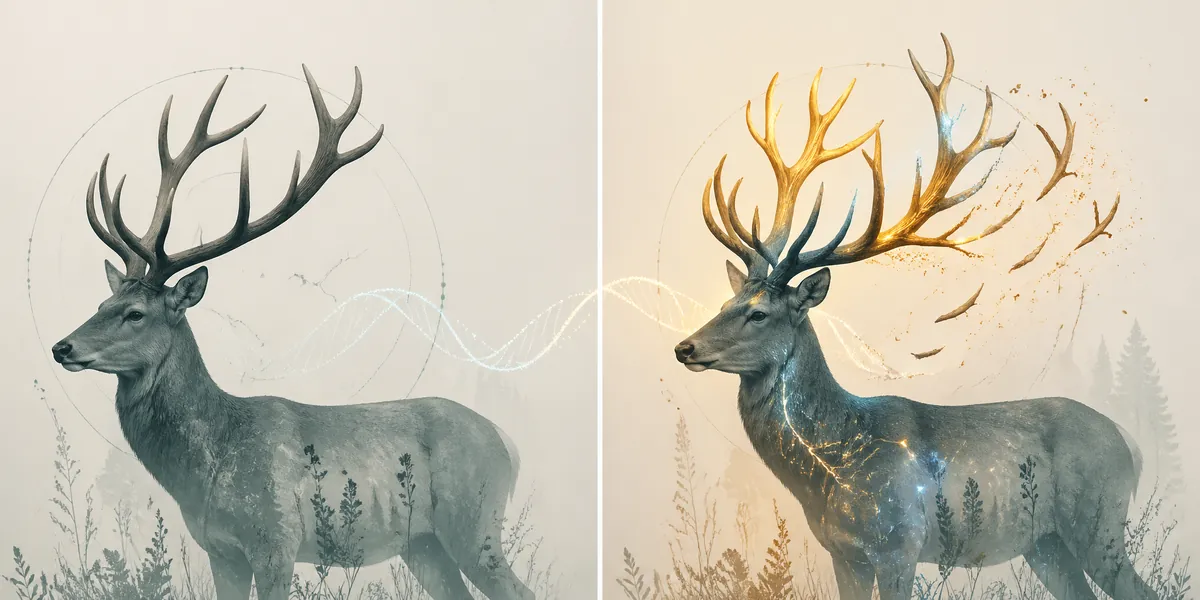
The Sika Deer Evo and the Evolutionary Theory of Hallmarks of Aging
In Eastern legend, the sika deer is a mythical creature revered for millennia. Its most mysterious ability is not its swiftness, but the annual shedding and regeneration of its antlers. Each regeneration produces new antlers that are larger, stronger, and more complex than the last.
We named this deer Evo — the embodiment of evolution.
In 2013, Cell journal published a landmark paper titled "The Hallmarks of Aging." It was the first to systematically distill the complex mechanisms of human aging into 9 core hallmarks. This paper has since been cited over 13,000 times and serves as the "common language" of the entire field of human aging science.
A decade later in 2023, the same authors updated the framework, expanding from 9 to 12 hallmarks. Two more years passed, and in 2025, the total was updated to 14 hallmarks — adding "extracellular matrix changes" and "psychosocial isolation."
Over more than a decade, this framework was updated only twice. Each update relied entirely on the cognitive boundaries of the same group of top human experts.
Meanwhile, new mechanisms, targets, and interventions discovered in laboratories worldwide every day are overwhelming the update speed of this language. The growth of knowledge has far outpaced the review capacity of human experts. The very language we use to describe aging is itself aging.
EvoSika's mission: to set this deer running.
No more waiting for expert updates. Let AI drive evolution.
On our platform, any scientist in the world can encapsulate their theory of aging as a Hallmark Agent. These Agents are continuously compared, scored, and ranked within the same Hallmarks Engineering Testbed. The best theories survive; flawed ones are eliminated. Two excellent but distinct theories spontaneously merge into an even better one.
Each time Evo sheds its antlers, it marks one iteration of hallmarks of aging theory.
Each time Evo grows a new set of antlers, it marks the birth of a superior causal explanation framework.
We do not know what the 15th or 20th hallmark of aging will be. But we know it will not come from a single review by one person — it will emerge from thousands of Evo Agents in ceaseless competition and collaboration across the same data forest.
EvoSika — Evolution is the only rule.
EvoSika Evolutionary Mechanisms
Not a database — a knowledge evolution arena.
Compete
Every aging theory is an Agent, competing on a unified benchmark. Data is the best judge.
Eliminate
Flawed theories are eliminated. Not authority — data decides. Survival of the fittest.
Merge
Two excellent but distinct theories spontaneously merge into a better one. The emergence of 1+1>2.
The Palantir of Biomedicine
As AI explodes across biomedicine, the real barrier is no longer compute power or models — it's chaotic data and missing standards.
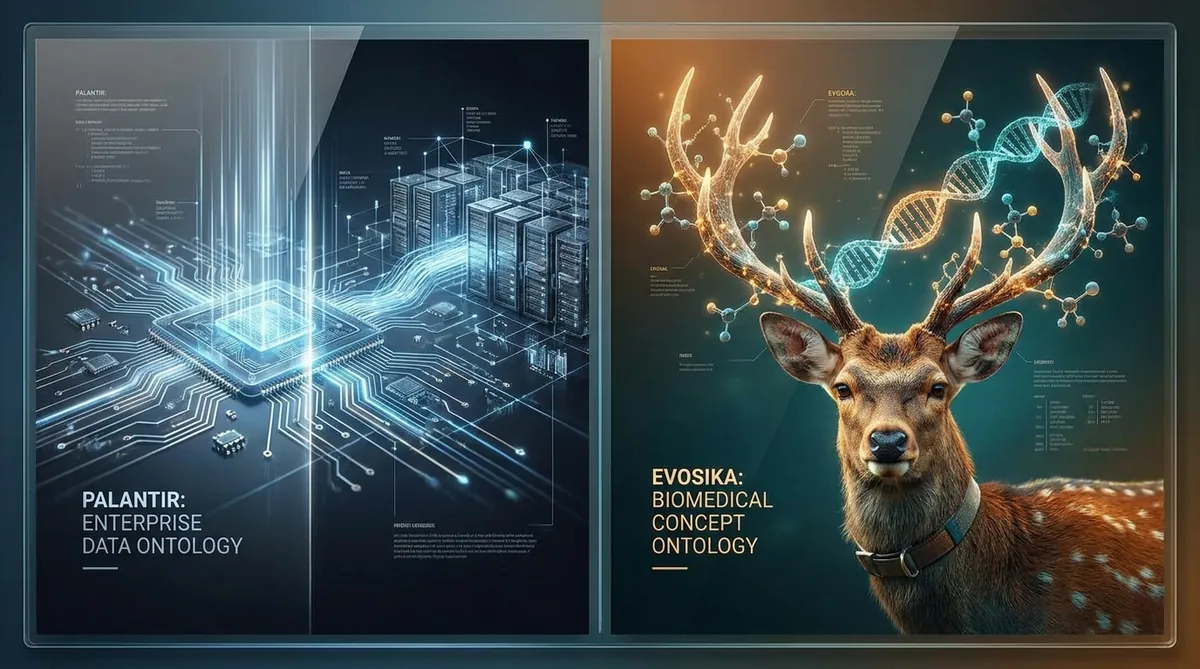
Palantir
Palantir proved this in enterprise services: from a "data stitching" company serving U.S. defense and intelligence, it grew into a nearly $400 billion AI infrastructure giant. Its core weapon isn't some AI model — it's "Ontology": a core technology that makes all heterogeneous data speak the same semantic language.
EvoSika
EvoSika is doing the same thing in biomedicine, but at a deeper level. Our "Gene Set Representation Method" is the "Ontology" built for biomedical knowledge.
Palantir defined the language of enterprise data. EvoSika defines the language of biomedical concepts.
Covering the Three Holy Grails of Biomedical Knowledge
Three Cell papers constitute the most authoritative theoretical frameworks for human disease, aging, and health. But they have never been engineered — until now.

Hallmarks of Cancer
Cell 2011
Cited 55,317 times
The common language of all cancer research. It defined the six hallmarks of cancer — the "Holy Grail" of cancer biology — yet has never been quantitatively assessed.
Hallmarks of Aging
Cell 2013/2023/2025
Cited over 13,000 times
Condensed aging mechanisms into 14 core hallmarks. Updated only twice in over a decade, entirely dependent on human expert review cycles.
Hallmarks of Health
Cell 2021
Emerging framework
An emerging field aiming to define "what health is" — yet to be fully applied.
EvoSika brings all three independent "language systems" into the same evaluation framework. Aging is our first battlefield, cancer is next, and health is the ultimate goal.
What Is the Real Moat of Pharma AI?
In April 2026, Bessemer Venture Partners (BVP) published an AI pharma infrastructure report noting: as compute costs continue to fall, the real moat of pharma AI is no longer models, but "bio-native data infrastructure."
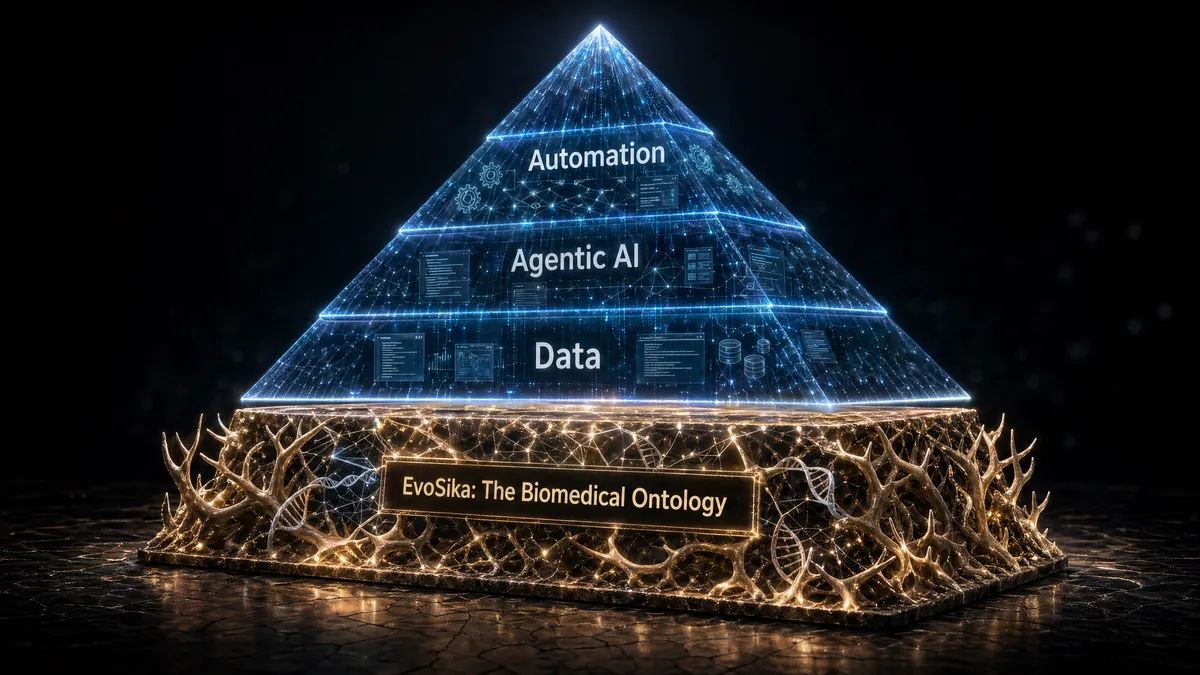
BVP frames this capability in three layers:
Scaled Bio-Native Data
Embedded Agentic AI Across Workflows
Closed-Loop Lab Automation
But this framework has an overlooked hidden premise: all three layers require the same "concept language" to function. The data layer needs unified concept labels, the Agent layer needs unified concept definitions, and the experiment layer needs unified standards of measurement.
EvoSika exists to solve exactly this foundational problem — providing a quantifiable, evolvable, and verifiable causal concept language for the entire AI pharma infrastructure stack.
Pharma companies are competing for the "data foundation." EvoSika is defining the "concept foundation." The former is raw material; the latter is grammar. Both are indispensable.
From Qualitative Concepts to Executable Language
Gene Ontology, KEGG, Reactome... these are the "basic vocabulary" of all human disease mechanisms. Yet for the same concept of "mitochondrial dysfunction," gene sets used by different teams can differ by over 50%. Medicine has a vast vocabulary but no standardized system of measurement.
EvoSika's "medical language compiler" was born to solve exactly this challenge. It transforms any qualitative biological concept into a quantifiable, evaluable standardized module.

Gene Set Representation (Standardization): Transform concepts like "Qi Deficiency" and "Genomic Instability" into authoritative gene set standards through our core invention.
Methylation/Proteomics Quantification (Compilation): Quantitatively detect these gene sets at the molecular level, converting language into numbers.
AI Evaluation Engine Verification (Execution): Test the concept's explanatory power and validity using public data in the Hallmarks Engineering Testbed.
Output: Valid concepts are retained, ranked, and deployed into applications; invalid concepts are eliminated or corrected.
The C language compiler freed programmers from writing machine code. EvoSika frees biologists from guessing "how important is this concept really" — the AI evaluation engine delivers the answer using public data. Palantir's "Ontology" maps directly onto this in the biomedical domain.
Two Orthogonal Biological Spaces
Physiological Space vs Pharmacological Space — When Fused, They Outperform Either System Alone
Aging Hallmarks gene sets come from MSigDB pathway databases — describing "which genes are involved in a biological process." This is the physiological space: what's happening in the cell. TCM efficacy term gene sets come from STITCH compound-target databases — describing "which genes are affected by drugs producing this effect." This is the pharmacological space: what can be intervened upon.
We discovered for the first time that these two spaces are nearly orthogonal — for the same organ concept, gene sets generated by the two methods have Jaccard overlap < 2%. This means they capture fundamentally different biological information. Fusing both spaces with data-driven selection, an 8-dimensional panel outperforms the 16-dimensional pure physiological panel across all tested diseases.
Two Orthogonal Spaces: The physiological space (MSigDB pathways) and pharmacological space (STITCH compound-targets) share < 2% gene overlap. In Alzheimer's disease, their cross-correlation is only 0.09 — they are nearly independent information dimensions.
Fusion Wins: Greedy selection from 28 dimensions (16 physiological + 12 pharmacological) picks 8 that beat the full 16-dim Aging panel across depression, Parkinson's, and Alzheimer's — higher accuracy with half the dimensions.
Druggable Information Ratio (DIR): The proportion of pharmacological dimensions in the optimal panel quantifies the knowledge gap. Depression DIR=50% (physiological knowledge insufficient), Parkinson's DIR=38% (physiological research partially covers it).
The pharmacological space is data-driven (millennia of empirical screening), while the physiological space is research-driven (accumulated human knowledge). When biological research on a disease is insufficient, pharmacological data can serve as an alternative feature space, bridging the knowledge frontier. EvoSika's evaluation framework is the first to let these two spaces compete and fuse on the same track.
Dual-Channel Panel vs Pure Aging Panel
Classification performance across 3 neurological/psychiatric diseases (5-fold CV AUC)
| Disease | Dual (8-dim) | Aging (16-dim) | Gain | DIR | Panel Composition |
|---|---|---|---|---|---|
| Depression | 0.652 | 0.596 | +0.056 | 50% | 4 Physio + 4 Drug (Yang+Heart+Qi+Lung) |
| Alzheimer's | 0.634 | 0.595 | +0.039 | 38% | 5 Physio + 3 Drug (Blood+Liver+Warmth) |
| Parkinson's | 0.732 | 0.704 | +0.028 | 38% | 5 Physio + 3 Drug (Lung+Yin+Spirit) |
DIR = Druggable Information Ratio. Higher DIR indicates the disease has less accumulated physiological knowledge, with pharmacological space providing critical complementary information.
In depression, the first dimension selected by greedy optimization is not any Aging Hallmark, but TCM "Yang" (vs_yang) — the pharmacological target gene set for Yang-tonifying herbs. This means the drug target space most frequently intervened upon for depression happens to capture its most critical biological differences. Even more striking: the pure compound level (L1) achieves AUC=0.661 in depression, surpassing the fused panel (0.652) — demonstrating that the finest-grained pharmacological data provides the strongest signal. This is the power of pharmacological space: it doesn't depend on understanding mechanisms — it depends on millennia of trial-and-error empirical screening.
The Precise Division of Labor in AI4Science
Building a car requires two things: a faster engine and a more precise map.
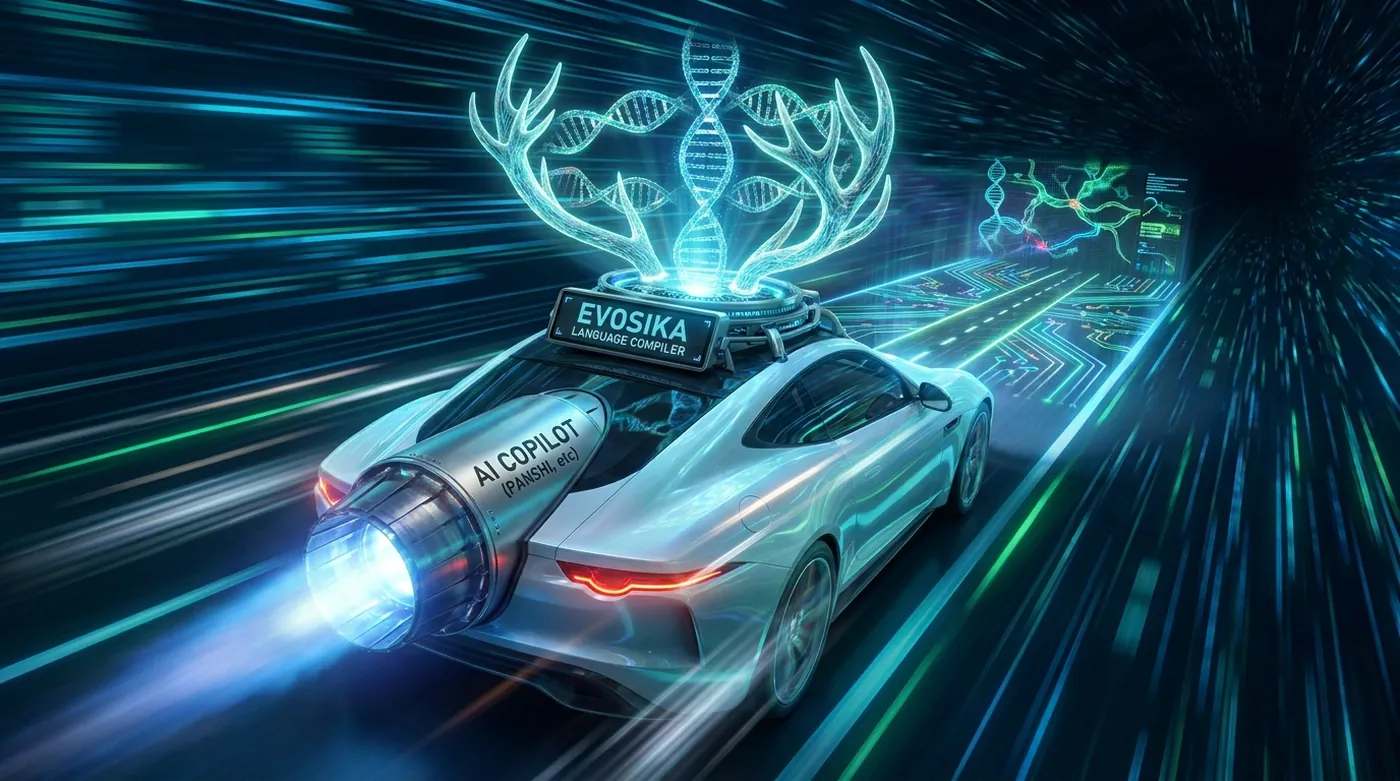
更快的引擎
The Chinese Academy of Sciences' Panshi model, Lingjing Zaowu, and similar platforms are building the "faster engine" — AI-assisted end-to-end research workflows, enabling scientists to read 1,000 papers a day. They are scientists' "research copilot," amplifying the scientist's capabilities.
更精确的地图
EvoSika is building the "more precise map" — ensuring that the causal root concepts proposed across those 1,000 papers are compared, eliminated, and merged within the same evaluation framework. We are the "language compiler of science," accelerating the conceptual language of science itself.
All AI4S platforms are making scientists stronger. EvoSika is bringing order to science itself.
The former accelerates individuals; the latter accelerates civilization. The two are complementary and indispensable.